How to Run a D&D Session Zero: Before the Dice Drop
Updated: Jan 20
So, you've decided to DM your first campaign and, after reading the DM guide you’re starting to feel a little overwhelmed. Before you panic-Google “how to write a fantasy world in 30 minutes”, take a page out of the Hitchhiker’s Guide to the Galaxy and D O N ’ T P A N I C. Is there a lot to do? Sure, but session zero is going to be the easiest step in your first campaign journey and I got you.
Whether you’re herding chaos gremlins or wrangling shy first-timers, Session Zero acts as your safety net and vibe check rolled into one. So, without further ado, LET’S GOOOOO!
What is a D&D session zero, anyway?
I like to think of a D&D Session Zero as the tutorial level for your campaign. It’s where the party meets, talks tone and expectations, talks about their characters, and you (the DM) lay the foundation for the world that you’re building.
While session zero is not the first session of the adventure, it is the first step in ensuring your players build a party that won’t be TPK’d before level three...
You don’t need to have your campaign lore developed or maps uploaded to DnDBeyond.com just yet. But you WILL need:
A basic campaign concept Give your players with a brief summary of the campaign and what the players can expect.
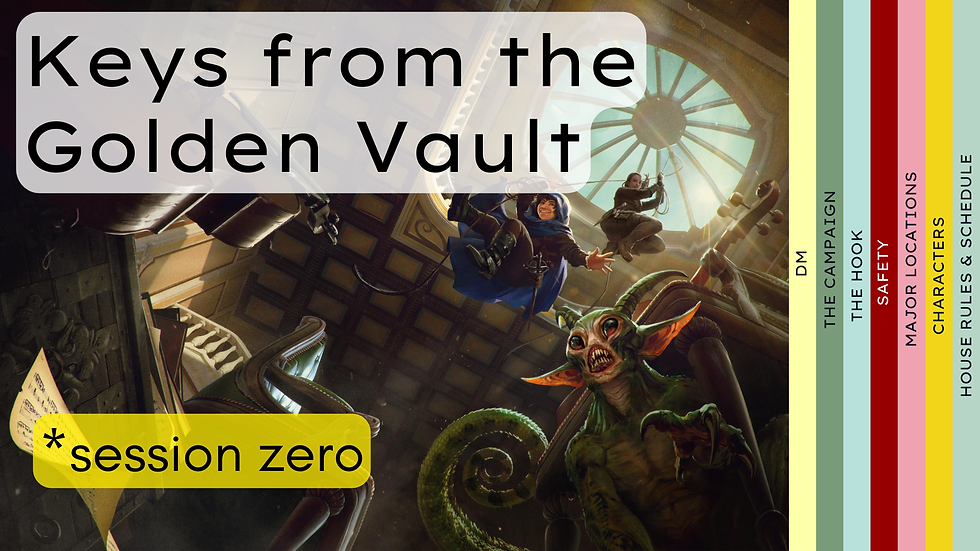
For my first campaign, I knew I wanted to do a heist campaign so I used The Keys from the Golden Vault adventure book as the root of my homebrew with elements from various heist movies and the Rick & Morty episode One Crew Over the Crewcoo’s Morty. This all sounded great in my head until a week before session zero when I realized my player’s characters were either chaotic neutral, lawful evil or just straight up neutral so I had to come up with how to make these little monsters viable candidates for the morally good Golden Vault organization. What I ended up doing was modifying the premise to fit the vibe my chaotic little kobolds were giving off and providing them with this summary:

“The Golden Vault is not a physical vault…rumored to be associated with metallic dragons, the Golden Vault is a secretive organization that has its base on one of the good-aligned Outer Planes. While its membership and activities are almost impossible for outsiders to track, those in the know are aware that they right moral wrongs and handle delicate situations local authorities won’t touch. Missions from the Golden Vault are often illegal, but they always support a just, moral cause. That being said, the Golden Vault has recently built a new base on one of the more chaotic good-aligned Outer Planes (Arborea) and started a “Second Chance program” that will allow them to offer their membership to “less than virtuous” adventuring groups who have proven themselves to be effective in retrievals. Your party is exactly the kind of ragtag team that a Golden Vault operative has had their eyes on for quite some time and they are now able to extend an offer for membership. There will be missions, montages and madness. LET’S FUCKING HEIST, BOYSSSSS!”
A short list of player safety tools Make sure everybody at the table (including you) feel safe with the content in the campaign. Talk openly about any hard or soft limits your players may have to avoid any out-of-bounds subjects (such as different types of violence, racism, romance and attraction, etc.) and any suggested ways to pause/stop play if anyone gets uncomfortable. Here are just a few examples of what to include in your ‘social contract’ with your players:
Hard limits vs. soft limits - a hard limit is a topic or situational content that is off-limits entirely while a soft limit (veil) are certain areas where some content is acceptable but needs to be handled delicately or with less detail.
The X Card - If a player gets uncomfortable they can raise a sticky note/white card/small sheet of paper with an ‘X’ on it to signal to the DM (and/or group). Playing virtually (Discord, Roll20, DnDBeyond, etc.)? Your players can type ‘X’ into the chat or even send it as a text to you.
Open Door Policy - Make sure your players know when you’re available to go over any character sheet questions, address any issues post-session or to answer questions they have about the campaign. For example, in my first campaign I created a Discord server with channels for announcements, in-game info, etc. for everyone to view recaps of the previous sessions and any info they may have forgotten and to post questions for the DM (me).
Post-session check-ins/“Stars & Wishes” - What did you enjoy? What do you want more of? What do you want less of? Would you like more focus on ___ character?
Character creation
This is when your players show up with either:
A fully built warlock with patron tailored to their three-act arc tragic backstory, or
“I wanna be… like sneaky but I also want to fight; regardless my character has anxiety”
Either way, meet them where they are.

Ask questions like:
“What kind of story do you not want to be part of?” OR “Will your character have a moral compass more like Robin Hood or like Dexter Morgan?” Asking these questions early can help you to determine if your campaign should be a lawful good hero's tale or a chaotic neutral/evil GTA: Medieval Times Edition.
“Are you planning on creating a homebrew character using an existing species?” Some experienced players might want to reflavor their character’ species or class to fit with their overall character idea (ie. reflavoring a changeling so the player can build a character sheet for Morph from X-Men) and it’s up to you to decide if that will be allowed. When you start to build your campaign, ask yourself: can players make minor tweaks to a species or class? Can players make minor/major changes to a species or class to be something different entirely? Do you allow players to play races they home-brewed themselves OR items they homebrewed? Are there any species’ or classes you would not allow in the campaign?
Use this time to: ✅ Help with character sheet setup ✅ Talk about party balance (but don’t force it) ✅ Encourage fun connections: “Oh you’re going with a ‘noble’ for the background? Awesome, maybe someone in your court hired the barbarian as your bodyguard…”
Set your campaign expectations early
You don’t need to reveal the big twist, but you should talk about tone and themes for sure.
Try questions like:
“Do y’all want high fantasy, steampunk, horror, or comedy?”
“What should the combat to roleplay ratio in this campaign be?”
“Do you enjoy solving in-game puzzles and riddles?”
“Which of these parts of a D&D campaign interests you the most: combat, exploration, or roleplaying?” and “How much balance would you want between the three?”

Also, make sure you go over logistics:
How often are we playing?
Online or in person?
What happens if someone misses a session?
How long is a typical session?
Bonus Tip: Set up a group chat or create a Discord server with channels for announcements (scheduling issues, cancellations, campaign polls, etc.), in-game info (NPC names and new locations), memes (who doesn’t love a good meme?), and any other channels you may need to make sure everyone is able to view any info they may have forgotten from previous sessions. I recently set up a Discord server for my group to use for our calls with our regular DnDBeyond VTT and it has added an extra layer of fun and chaos to our sessions (we use the soundboard A LOT during roleplay and combat)!
Rule clarifications
This is a great time to gently clarify what the players can expect from you, the DM:

House rules are optional rules that you create as the DM (more information is found in the Dungeon Master’s Guide) and can be anything from allowing players to be able to drink a potion as a bonus action to letting your players pick their place in initiative if they roll a Nat 20. You can have a short list of house rules ready for session zero or collaborate with your players prior to session zero to help build the rules together. If a house rule doesn’t end up working as well as you thought, don’t beat yourself up; revise and retry :)
Leveling method Make sure your players are aware of how they will gain experience throughout the campaign by choosing either Milestone or XP leveling. If you want your players to level up after completing a quest (or predetermined number of quests)/specific story goals, Milestone would work for you. On the other hand, if you want your players to accumulate their experience points through encounters or you’re using an adventure book for your campaign, XP may be the preferred option.
Your DM style Are you strictly following the rules as written (RAW) or do you want the flow of the story to take precedence and follow the Rule of Cool? Depending on the overall vibe of the campaign, doing a little of both can be fun.
Let your players know: “I may not have every rule memorized, but we’ll keep the game flowing” Personally, I use the Rule of Cool a lot more often than RAW (rules as written) and it opens up more roleplay opportunities with my players. Allowing my players to describe spells or abilities as their character would use them has been both hilarious and insane; 14/10 recommend.
Maybe roleplay some bonding exercises with the party
Got time after the session zero wraps up? Try one of these:
“Tavern Tales” Icebreaker Each player creates and shares a one-sentence rumor about their character.
Flashback Scenes Mini roleplay scenes where pairs of characters recall a past moment together.
The “Oops, we’re a team now” hook Drop a mini encounter to test the party’s cohesiveness and if you can’t think of a monster to use, remember literally ANYTHING can be a mimic if you believe in yourself.
Session Zero checklist (for the chronically forgetful) | Session Zero presentation
image of the Heady Bard free printable '5 details to include in your session zero' image of the Heady Bard free Canva template 'D&D Session Zero Presentation'
If you're only having a brief info sesh with your players before starting session one, download my free 5 details to include in your Session Zero to help remind you of the important details.
And if you want to make a fun presentation for your players, download my free D&D Session Zero Presentation (Canva template).